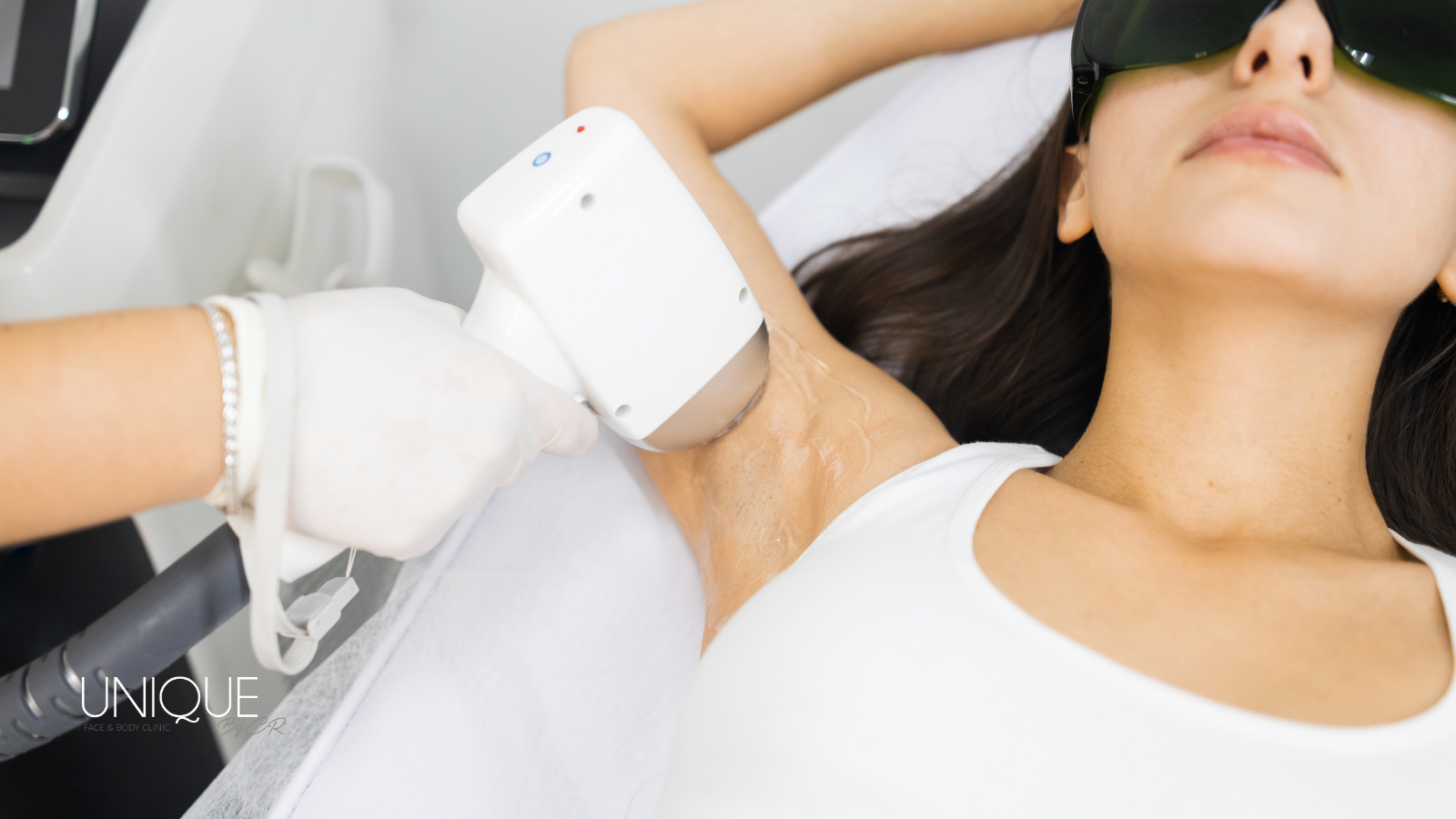
Laser Hair Removal offers an alternative to traditional hair removal methods. Read on to learn about the different types of laser used and the essential aftercare needed to get the best results.
As the beauty industry has evolved, Laser Hair Removal has emerged as a fast, long-lasting approach to easing the discomfort and self-consciousness caused by unwanted hair, delivering effective and durable results to clients.
In this article we walk through the aftercare you should follow and the differences between the four types of Laser Hair Removal: Diode, Alexandrite, Nd:YAG and Intense Pulsed Light.
How does Laser Hair Removal work?
During laser hair removal the laser emits beams of light that are converted into heat. That heat is directed at the hair follicle during its anagen phase (the growth phase), acting on the hair pigment. The result is damage to the follicle that prevents or slows further growth. For this reason darker hair, with a higher concentration of melanin, tends to respond more effectively to laser hair removal.
Hair growth has 3 phases: anagen, catagen and telogen. Hairs cycle through all of these phases at different times.
With technologies such as pulsed light (photoepilation) or laser, the ideal scenario is for the hair to be attached to the root (anagen phase) so the root can be reached and cauterised.
This is why several sessions are needed to make sure the laser reaches the root of every hair.
What happens after a laser hair removal session?
After the laser hair removal session the hair falls out lifeless from about 15 days after the appointment. And if it was hit during the anagen phase, that follicle will not grow new hair.
It's important to note that not every body hair is in the same growth phase, and that cycle is permanent for as long as the follicle stays active.
That is why a 30-day-plus break between sessions is justified — so any hair that wasn't in the right phase (anagen) at the time has the chance to develop and reach the correct phase by the next session.
What types of laser are there?
Diode Laser
The Diode laser is highly sought after for its ability to penetrate deeply into the skin, thanks to its 800 nm wavelength. This laser is suitable for every skin phototype and is especially effective on dark, coarse hair.
Alexandrite Laser
The Alexandrite laser uses a 755 nm wavelength. It is best suited to less pigmented hair and to people with fair to medium skin tones. While it can also be used on darker skin, it's important to consult a professional first to avoid potential pigmentation issues.
Nd:YAG
The Nd:YAG laser (neodymium-doped yttrium-aluminium-garnet laser) has a 1064 nm wavelength that allows it to penetrate the skin deeply, bypassing the melanin in the epidermis and concentrating its energy on the deeper hair follicles.
Because of this, it is suitable for every skin phototype and is especially effective on higher phototypes (darker skin tones).
Intense Pulsed Light
Intense Pulsed Light (IPL) is not classified as a laser, although the way it works is similar. The device emits flashes of light with wavelengths between 500 and 690 nm. Because it penetrates less deeply, this option can be less effective and may require more sessions compared with laser treatments.
This technology is effective on every skin type and over larger areas.
What aftercare should you follow?
After a laser hair removal session it is important to follow some aftercare so the treatment is more effective and the experience is positive.
- Use a moisturising cream to help restore hydration and reduce skin sensitivity.
- Avoid direct sun exposure — apply sunscreen every day, even when it's cloudy, with SPF 35 or higher.
- Avoid products with chemical exfoliants for the first 7 days after the session.
- Avoid make-up for the first 24 hours after the session.
- Avoid tight clothing and friction — choose loose-fitting clothes and soft fabrics.
- When showering, use your hands and warm water — avoid sponges or abrasive brushes.
- Avoid swimming pools, saunas and intense exercise.
- Wait 24 hours before applying deodorant.
What age can you start having hair removal?
Laser hair removal is the best hair removal method for teenagers, since it is a permanent, non-invasive, safe treatment and is less painful than other traditional methods.
Recommended age — Male: 16 years old. Female: one year after the first menstrual cycle.